
CasaXPS

Advanced processing software for XPS, AES, SIMS, and spectromicroscopy data.

25+
Years of Supporting the
Surface Science Community

About CasaXPS

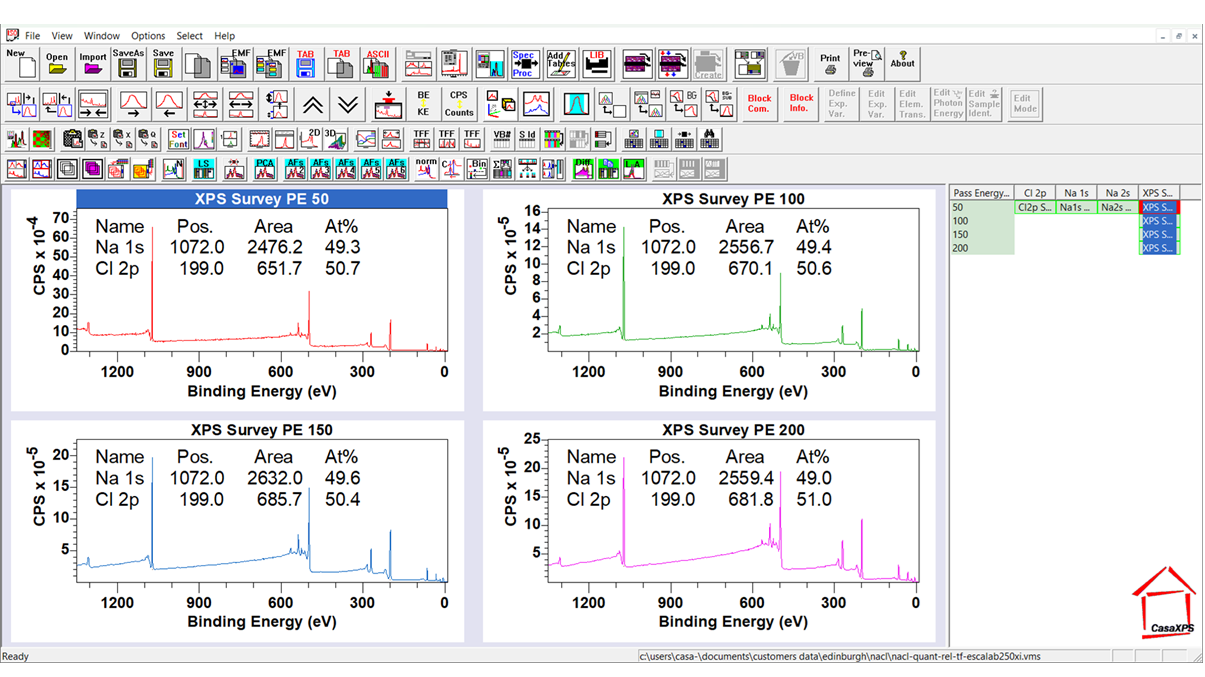
CasaXPS processing software offers powerful analysis techniques for both spectral and imaging data. The system originally designed for XPS and Auger data now offers features covering a wide range of analytical techniques including ToF SIMS, dynamic SIMS and many more.

  • Full quantification including transmission correction.
  • Configurable quantification reports.
  • Background types: Linear, Shirley, Tougaard, and cubic-spline.
  • Asymmetric and symmetric line-shapes: Doniach-Sunjic, Voigt, GL, etc.
  • State-of-the-art image processing for XPS spectromicroscopy.

Get Started Today

Try the full features of CasaXPS for free.

A site license allows CasaXPS to be used throughout a university.
Numerous site licenses are owned by universities around the world (click here for list).

To determine if your institute is already covered by a site license or to make enquiries about purchasing licenses for CasaXPS, please contact neal@casaxps.com.

XPS Video Channel

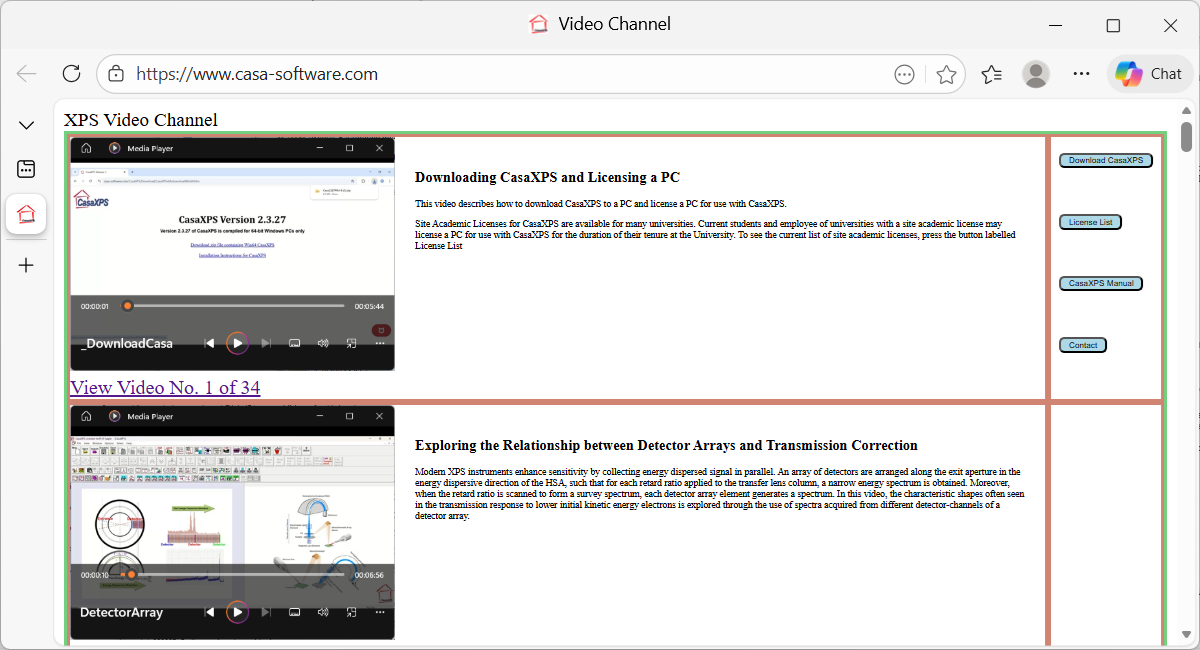
Videos and resources used in the making of videos are added to the XPS Video Channel.

XPS Video Channel Interface

Recent Research Using CasaXPS

Systematic and collaborative approach to problem solving using X-ray photoelectron spectroscopy

Fairley, N., Fernandez, V., Richard‐Plouet, M., et al., 2021.
Applied Surface Science Advances.

Abstract

The methodology presented within this work is a result of years of interactions between many junior and senior X-ray Photoelectron Spectroscopy (XPS) users operating within the CasaXPS spectral processing and interpretation program framework.
Read Full Article →

Combining PCA and nonlinear fitting of peak models to re-evaluate C 1s XPS spectrum of cellulose

Fernandez, V., Morgan, D., Bargiela, P., et al., 2023.
Applied Surface Science.

Abstract

Cellulose is an example of a material that responds to XPS by the creation of new chemistry not present in the as-received sample. In this work, these problems are illustrated through an analysis of cellulose spectra obtained during a degradation study.

Read Full Article →

Guide to XPS data analysis: applying appropriate constraints to synthetic peaks in XPS peak fitting

Major, G.H., Fernandez, V., Fairley, N., et al., 2022.
Journal of Vacuum Science & Technology A.

Abstract

Peak fitting of x-ray photoelectron spectroscopy (XPS) data is the primary method for identifying and quantifying the chemical states of the atoms near the surface of a sample. Peak fitting is typically based on the minimization of a figure-of-merit.

Read Full Article →

Generalized molybdenum oxide surface chemical state XPS determination via informed amorphous sample model

Baltrusaitis, J., Mendoza-Sanchez, B., Fernandez, V., et al., 2015.
Applied Surface Science.

Abstract

Accurate elemental oxidation state determination for the outer surface of a complex material is of crucial importance in many science and engineering disciplines. Unlike traditional XPS spectra fitting, we present a method based on vector analysis.

Read Full Article →

Chemical State Analysis by Nonlinear Least Squares Fitting

Stay current with the latest developments in surface science. Our software is utilized in groundbreaking research across materials science, catalysis, and semiconductor physics.

  • Standardizing XPS Data Formats
  • Curve Fitting Strategies for Complex Oxides

Need Detailed Manuals?

We provide the full CasaXPS Manual and the Computer Aided Surface Analysis eBook.

Browse Books & PDF Library
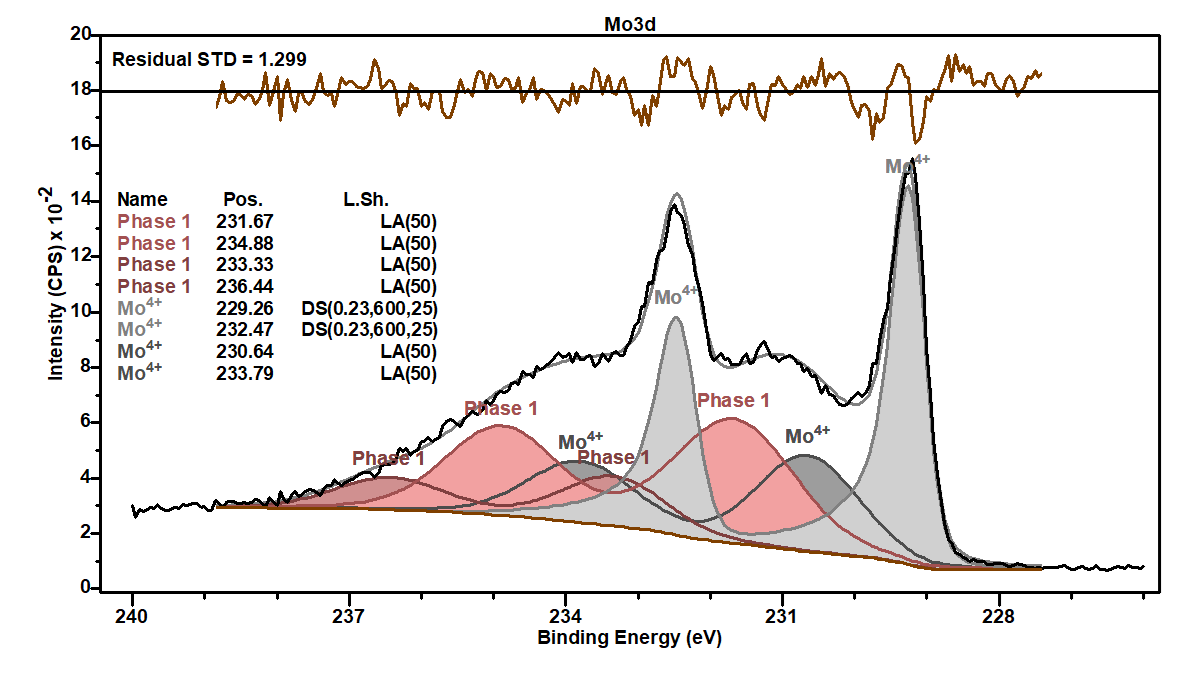
Peak Model Fitting Example

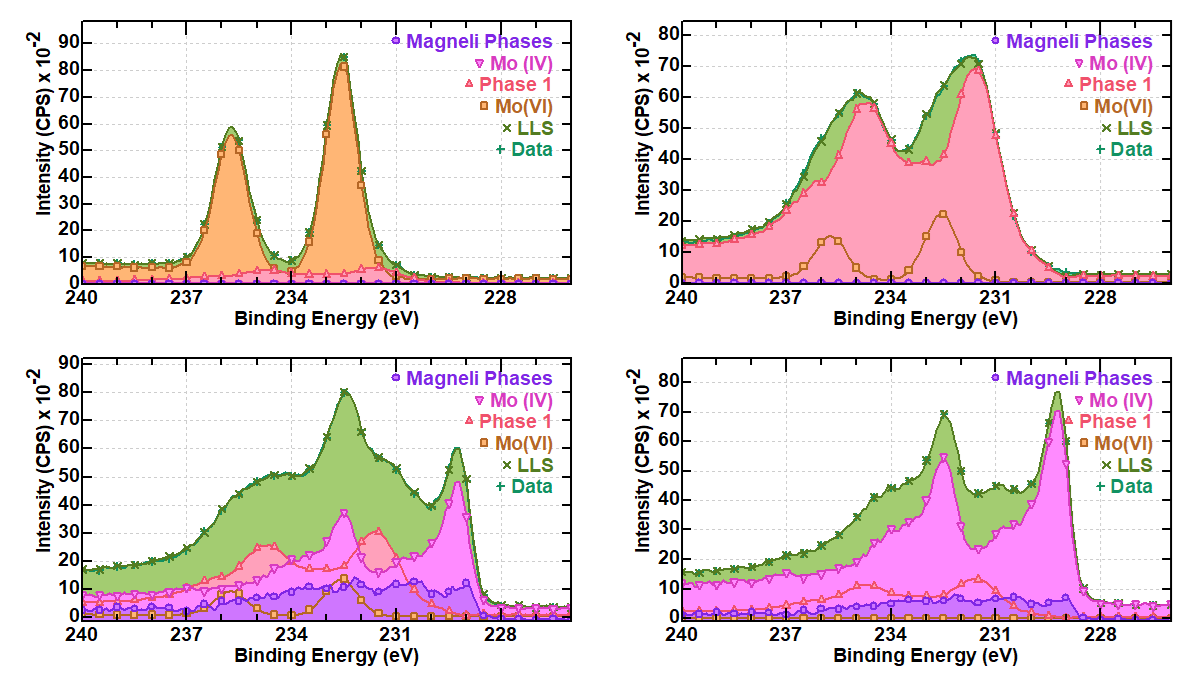
PCA & Linear Least Squares Decomposition

Analysis of evolving spectra by Principal Component Analysis (PCA) and Linear Least Squares (LLS) provide tools to examine complex oxide spectra. This offers a robust alternative to constrained parametrically defined peak models.

Perfect for analyzing depth profiles, angle-resolved data, or complex degradation studies.

PCA/LLS Analysis Example

Advanced Quantification

Quantification by XPS involves measuring the intensity of photoelectron peaks and then applying adjustments to these intensities that account for sample, instrumental and physics impacts on the recorded intensities.

  • Transmission function correction
  • RSF Library management
  • Effective attenuation length calculations
XPS Quantification Process

Published Books & Technical Guides

Free eBooks and detailed PDF guides designed to help you master CasaXPS.

Free eBooks

Cover
XPS AES ToFSIMS and Dynamic SIMS

Analysis of Data from a range of techniqes.

Download eBook →
Cover
CasaXPS XPS Manual

Software features used for XPS Data Analysis.

ISBN: 978-1907465000

Download eBook →
Cover
XPS Primer

XPS Primer: An Introduction to the XPS Technique.

Download eBook →

Online Documentation

The CasaXPS Online Manual

Access the complete documentation online. This comprehensive resource includes in-depth technical guides, step-by-step processing procedures, and detailed reference material for all software features.

View Online Manual

Purchase Options

Choose the license type that best fits your research or commercial needs.

Academic Licenses
Single User Individual researcher
€830.00
Site License Campus-wide access
€2,490.00
Commercial Licenses
Single User Individual professional
€1,585.00
Site License Building-wide access
€4,988.00
A site licenses allows CasaXPS to be used throughout a university. Numerous site licenses are owned by universities around the world (click here for list). To determine if your institute is already covered by a site license or to make enquiries about purchasing licenses for CasaXPS, please contact neal@casaxps.com.